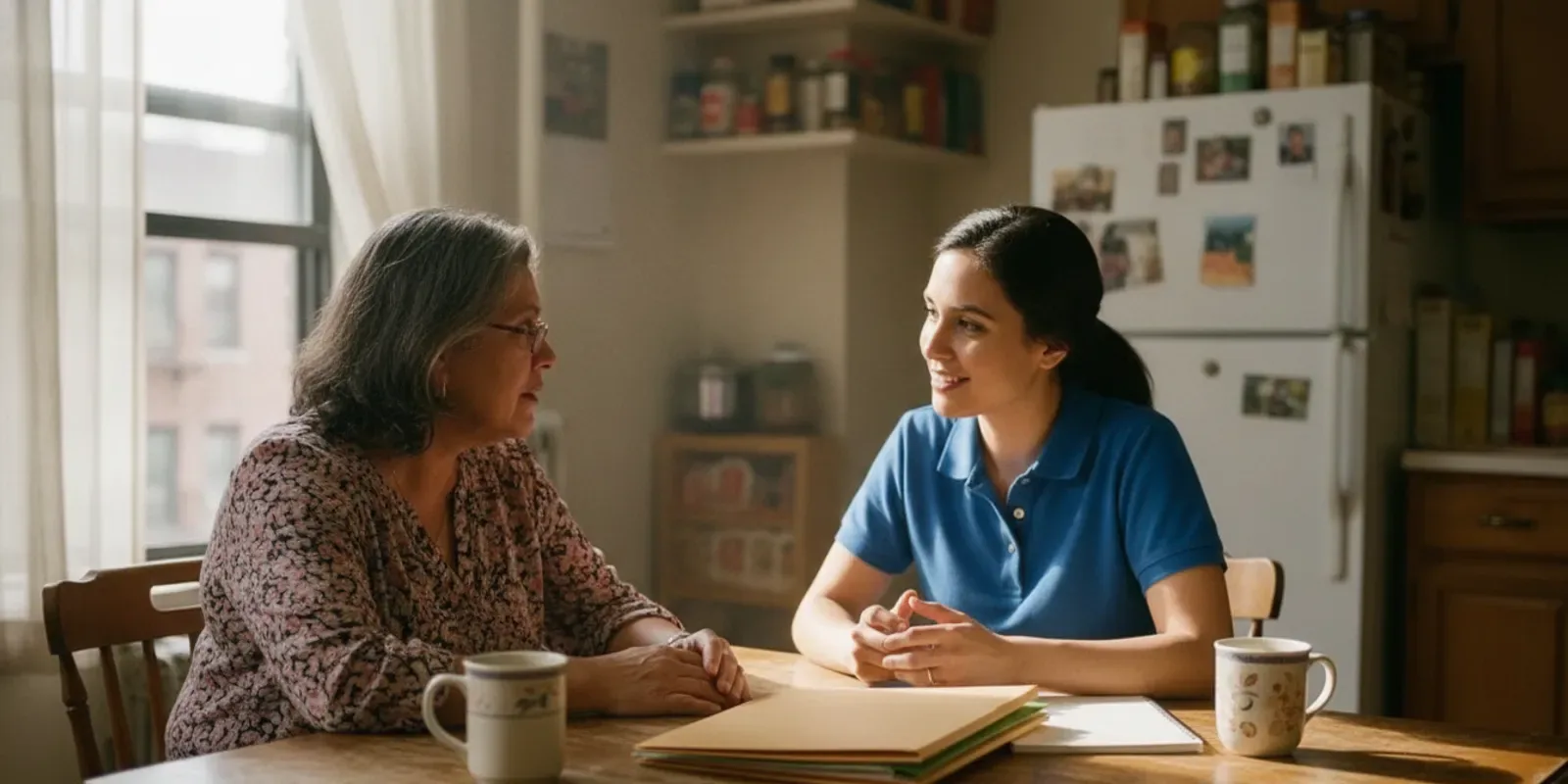
Call (646) 961-8942 to discuss OPWDD next steps
What OPWDD does
OPWDD is the New York State agency that coordinates and oversees supports for eligible people with intellectual and developmental disabilities. Depending on eligibility and program rules, supports may include care coordination, in-home assistance, community-based services, respite, employment or day supports, and self-direction. OPWDD eligibility is not automatic, and an application or referral does not guarantee a determination, service authorization, hours, placement, or funding.
Medicaid is a public health coverage program that may help pay for certain eligible services. An OPWDD eligibility decision and Medicaid or waiver authorization are related but not identical steps. A waiver is a program pathway with its own requirements and services. Self-direction is an option in which an eligible person or representative has a greater role in directing approved supports. Because these terms can be used differently across programs, families should follow the instructions in their own correspondence.
How to apply for OPWDD services, stage by stage
The process can vary, but most families benefit from thinking about the application as a sequence rather than one form. Keep a single folder, digital or paper, for notices, evaluations, contact names, questions, and submission confirmations.
1. Start with the OPWDD Front Door
OPWDD calls the Front Door the way it connects someone to services. The public start is the OPWDD Infoline at 866-946-9733. Ask to be transferred to the local Front Door office, and tell the operator the county where the person lives. New York City families name the borough's county. Westchester families name Westchester. Ask whether the next step is an information session, an intake meeting, or a records request. Write down the staff name and the date before you hang up.
A school team, pediatrician, care manager, social worker, hospital discharge planner, or community organization may sit with the family. They should not replace the person or guardian on the call. OPWDD also posts Front Door videos in several languages, including English, Spanish, and American Sign Language. Those videos explain the entry. They do not replace the local office. Confirm the current number on OPWDD's Front Door page before you rely on an old flyer.
Amelia’s OPWDD application help page describes how its team can help families organize process questions and next steps. It is a service resource, not a substitute for an OPWDD determination or official notice.
2. Gather records that explain the person’s needs
Collect records before sending anything, while recognizing that the reviewing agency or program may request different documents. Useful records may include developmental, psychological, neurological, or medical evaluations; school or early-intervention records; treatment summaries; medication information; descriptions of adaptive functioning; and records that explain how support needs affect daily life. Include dates, provider names, and contact information when available.
Do not send more sensitive information than the recipient needs. Confirm the secure submission method, ask whether a signed release is required, and keep a copy of every document. A simple index can list the document name, date, who prepared it, where it was sent, and when it was accepted.
3. Complete the eligibility and assessment steps requested
OPWDD may request specific assessments or additional records to understand developmental history and current support needs. For a child, the requested materials may include school-based or clinical evaluations and information about adaptive skills. In some situations, an assessment such as the Children’s Assessment of Needs and Strengths (CANS) may be part of the information-gathering process. The exact requirements depend on the person and the current program pathway, so a family should not assume that one checklist applies to every applicant.
Answer questions consistently and concretely. Examples of daily support needs can be more useful than broad descriptions: help with communication, personal care, safety awareness, routines, mobility, eating, community participation, or transitions. Explain what happens on a typical day, what support is needed, and what changes when a caregiver is not present. Ask the evaluator to explain any form or term that is unclear.
4. Track determinations, referrals, and next actions
When an office or organization sends a determination, referral, or request for more information, read every page and mark the date received. Record what was decided, what remains open, the response method, and the deadline listed in the notice. If a document is missing or appears incorrect, ask the sender how to raise the issue and keep that communication with the notice.
A family may also be connected with care coordination. Care coordination can help organize a person-centered plan, communicate with providers, and identify services that may fit the person’s approved pathway. It does not change the underlying eligibility rules. Amelia’s OPWDD care coordination resource can help readers understand the role of coordination while they confirm program details with the responsible office.
5. Discuss available supports only after eligibility and program requirements are clear
Once the responsible agencies confirm the pathway, ask which supports can be considered. Also ask who authorizes them, and which enrollment steps remain. A person may be eligible for one support and not another. Available hours, caregiver arrangements, provider choice, self-direction, and funding depend on the person’s determination, plan, authorizations, and current rules.
For families exploring self-direction, Amelia explains the concept in its OPWDD self-direction guide. Self-direction can involve added responsibilities for the person or representative, and it does not guarantee a particular caregiver, pay rate, service, or result.
A practical OPWDD application checklist
- Write down the person’s full name, birth date, preferred language, and the family or representative contact.
- List the main support questions in plain language, including safety, communication, daily living, school, work, and community needs.
- Collect relevant evaluations and records, then note the date and source of each one.
- Ask which documents are required, which are optional, and how they should be submitted securely.
- Request written confirmation when a submission is received if the office offers it.
- Keep the names, titles, phone numbers, and email addresses of people involved.
- Save every notice, determination, referral, and plan in date order.
- Mark each deadline on a calendar and ask promptly when a notice is difficult to understand.
- Share only the information necessary for the referral or review, using consent-aware practices.
How the early steps differ
Families often treat the first phone call, the eligibility review, and a later service plan as the same event. They are not. Use this map to see what each step can and cannot do. The notice in your file still controls your case.
| Step. | What it is for. | What it does not do. |
|---|---|---|
| Front Door call. | It connects the county to the local OPWDD entry office. | It does not approve services or assign a caregiver. |
| Information session or intake. | It explains pathways and starts a picture of needs. | It does not finish eligibility or pick every support. |
| Eligibility review. | OPWDD reviews records and then sends a written result. | It does not by itself enroll Medicaid or start paid care. |
| Later planning. | It builds supports after eligibility, often with a coordinator. | It does not guarantee hours, a family caregiver, or a date. |
What if the family disagrees with a decision?
The word “appeal” can describe several different situations, but the route depends on the action and the notice. A general disagreement about an application, eligibility decision, service, or plan should first be matched to the written instructions provided by the responsible agency or provider. Families should preserve the notice, identify the exact decision, write down why they disagree, gather relevant records, and follow the response method in the notice.
Objection to a service action
OPWDD’s due-process guidance describes an objection process for certain proposed service changes. That can include discharge, a cut or end to an HCBS waiver service, or a change to a service plan. The page may refer to the person, family, or representative working through the process tied to that service action. The notice and the responsible provider should control the next step, not a general internet checklist.
Agency conference
An agency conference is an informal opportunity to discuss a disputed decision with the agency or organization involved. Under the OPWDD guidance for the CCO/HH Notice of Determination process, a person may request an informal Agency Conference with the person or representative, the CCO/HH, and an OPWDD representative. Whether an agency conference applies to a particular issue, and how to request it, should be confirmed from the notice.
Fair Hearing
A Fair Hearing is a formal proceeding in which the person and the agency can present evidence about a determination. For the CCO/HH Notice of Determination process described by OPWDD, a person has 60 days from the notice date to request a Fair Hearing. The request goes to the Office of Temporary and Disability Assistance (OTDA). This 60-day statement is specific to that Notice of Determination process. It is not a universal deadline for every OPWDD action or service issue. The notice controls, so read it carefully and confirm the correct deadline and request method.
For background, read OPWDD’s official Due Process, Notice of Determination, and Fair Hearings guidance and OTDA’s Fair Hearings frequently asked questions. These pages provide general information; they do not replace advice about a person’s specific case. If the deadline is close, the family should follow the notice and seek qualified assistance promptly rather than waiting for an informal response.
How referral professionals can help
Care managers, social workers, hospital discharge teams, care-coordination staff, and nonprofit or community-organization professionals may be the first people a family asks for direction. A helpful referral does not promise eligibility or a result. It gives the family a clear next action and protects privacy.
- Ask the family what they want help understanding: an application stage, a missing record, a notice, a care coordination question, or an authorized service.
- Obtain the family’s permission before sharing personal, developmental, medical, or benefits information with another organization.
- Use the receiving organization’s approved secure method. Avoid putting diagnoses, full case histories, or identifying documents in an unprotected email or referral note.
- Send the minimum information needed to begin the conversation, and tell the family what was shared and with whom.
- Give the family a copy of the referral details, contact information, and any next appointment or response expectation.
- Do not describe Amelia as able to approve OPWDD eligibility, change an agency determination, guarantee service hours, or promise placement.
Professionals who need a practical referral pathway can review Amelia’s home care referral guide for social workers. Families can also use the free consultation page to ask what information may be useful before an intake conversation. Consent and privacy still apply to every referral.
How Amelia can support next-step planning
Amelia Home Care is a New York Licensed Home Care Services Agency. It helps families navigate OPWDD and Medicaid-funded in-home care when the person and the service meet program rules. Families in Brooklyn, the Bronx, Manhattan, Queens, Staten Island, and Westchester County can use that help while they prepare for the Front Door. Intake is bilingual, and aides may speak seven languages, depending on service needs and program rules. Its team can help organize questions, document requests, and process-management steps. Amelia’s app supports digital document submission and updates during the process. Those tools can make communication easier, but they do not guarantee approval, eligibility, faster processing, service hours, caregiver placement, payment, or any other outcome.
Families may also ask about bilingual intake and caregiver options. When eligible and when program rules allow, an eligible family member may be able to become a paid caregiver through an applicable self-direction arrangement. That possibility depends on the person’s program, authorization, role requirements, and other rules. It should be confirmed for the individual case.
For the stated OPWDD eligibility context, families are often told that the child’s income, rather than the parent’s income, is considered. This is not a guarantee of eligibility or services, and income treatment can depend on the person’s circumstances and program. Ask the responsible office to explain the current rules.
Eligible Medicaid-, OPWDD-, or VA-funded services may be available at $0 cost to a family, subject to eligibility, authorization, enrollment, and program rules. Families should not assume that every service is funded or that a referral will result in payment.
If you are organizing an OPWDD application or referral, request a free consultation with Amelia to discuss the next questions and documents.
Frequently asked questions
How long does an OPWDD application take?
There is no single timeline that applies to every person or stage. Records, assessments, eligibility review, care coordination, notices, and authorizations can move at different speeds. Four to six months is sometimes reported as a typical planning range for parts of the process, but it is not a promise. The family should track the specific dates and requests in its own case.
Can a parent apply for a child?
A parent or legal representative may help a child communicate and complete process steps, subject to the requirements of the responsible agency and the child’s circumstances. Ask what consent, representation, and documentation are required before sharing records or requesting information.
What should a family do if a notice is confusing?
Keep the original notice, mark the date it was received, and write down the sentence or decision that is unclear. Contact the office named in the notice and ask for the response method and deadline in writing. If the issue involves a proposed service change or a CCO/HH Notice of Determination, ask which objection, agency conference, or Fair Hearing route applies. Do not assume that the CCO/HH 60-day Fair Hearing period applies to every OPWDD matter.
Take the next step carefully
A clear folder, a dated checklist, and a privacy-aware referral can make the OPWDD process easier to follow. The most important rule is to match the action to the current notice and program instructions. Amelia can discuss process questions and possible next steps, while OPWDD, OTDA, Medicaid, and the responsible program or provider make determinations under their applicable rules.
Call (646) 961-8942 to discuss OPWDD next steps or visit Amelia’s contact page to begin a privacy-conscious conversation.