Starting the OPWDD process can feel like a lot to manage, especially when your family is already coordinating care, school, and appointments. An OPWDD documentation checklist can help you organize what you have, note what is missing, and prepare questions for the next conversation. OPWDD means the New York State Office for People With Developmental Disabilities. The records that may be useful depend on the person’s situation; this is a planning aid, not an official or complete list of required documents.
What does an OPWDD documentation checklist do?
OPWDD coordinates supports for eligible people with developmental disabilities in New York. Families may encounter different assessments, applications, and service-planning steps along the way. Having key information in one place can make conversations easier, but collecting paperwork does not establish eligibility or guarantee approval, services, or a timeline.
Think of the checklist as a way to prepare—not a test you must pass before asking for help. You can begin with records already available and ask the relevant care coordinator or OPWDD contact which items apply. Amelia Home Care is a New York Licensed Home Care Services Agency that supports families navigating OPWDD and Medicaid-funded in-home care. Learn more about OPWDD and home care for children with special needs.
Which records may help you prepare?
Gather what is relevant and available. Do not delay asking questions just because a record is missing. A family may find it useful to make a folder—paper or digital—with items such as:
- Basic contact and identification details: the person’s legal name, date of birth, home address, and the names and contact details of a parent, guardian, or other authorized representative, as applicable.
- Existing clinical records: evaluation reports, diagnostic information, summaries from clinicians, and other records that describe strengths, support needs, and relevant health history. Ask the professional who holds a record how to request a copy.
- School or early childhood information: current or recent plans, evaluations, progress notes, or summaries that help explain how the person learns, communicates, and participates in daily activities. These can provide context; they are not a substitute for any required OPWDD assessment.
- Current support information: a short description of help needed with communication, personal care, routines, safety, community participation, or other everyday activities. Include what the person can do independently and what support works well.
- Relevant service and coverage details: information about current services, Medicaid status if known, and the names of providers or coordinators already involved. Medicaid is a public health coverage program; eligibility and service authorization are determined through applicable program processes.
- Questions and follow-up notes: write down who you spoke with, the date, what they asked you to do, and any deadlines they gave you. Confirm important instructions with the source responsible for that step.
This list is deliberately broad. A specific application, assessment, or service request may call for other records, and some listed items may not apply to your family. The New York State OPWDD website is an official starting point for current agency information. Check the instructions for your particular step rather than assuming one document list fits every person.
How can you keep documents organized?
A simple system can reduce repeated searching and make it easier to respond when someone requests information. It does not need to be complicated.
- Choose one secure home for records. Use a folder or a password-protected digital location that the appropriate family members or representatives can access. Keep sensitive personal and health information private.
- Sort by topic. Separate identification and contact information, clinical records, school records, current services, and correspondence. Add a date to filenames or paper notes so you can tell which version is newest.
- Make a one-page overview. Note the person’s strengths, communication preferences, daily support needs, current services, and the family’s main questions. Keep it factual and avoid sending private details to people who are not involved in the process.
- Track requests and submissions. Record what was requested, who requested it, how it should be sent, when you sent it, and whether receipt was confirmed. Keep copies of documents you share.
- Ask before sending sensitive records. Confirm the recipient, permitted method, and any authorization needed. Do not rely on an informal email address or an unverified link for sensitive information.
Amelia’s app supports digital document submission and real-time updates during the OPWDD process. These tools can help families keep track of communication, but they do not determine eligibility or guarantee approval, processing speed, service hours, or a particular outcome. For a general overview of pediatric home care in New York, see the service information for families.
What should families clarify about Medicaid and eligibility?
Families often worry that their own finances or a missing piece of paperwork will prevent them from exploring support. Ask which rules apply to the person and the program being discussed. Amelia’s stated guidance for OPWDD applications is that the child’s income, rather than the parent’s income, is considered; this is not a guarantee of eligibility, and individual circumstances and program rules matter. For broader background, see Amelia’s guide to Medicaid income limits in New York, then confirm questions about your situation with the appropriate program contact.
A waiver is a program pathway that can support certain services for people who meet the applicable requirements. The phrase “Medicaid waiver” does not mean that every person qualifies or that every service is automatically covered. Ask the care coordinator to explain which program or service pathway is being considered, what information is needed, and who makes each decision.
What questions can make a conversation more useful?
Whether you are a parent, care manager, social worker, hospital discharge planner, or community organization staff member, clear questions can help identify the next responsible step. Consider asking:
- Which step are we working on now, and who is responsible for it?
- Which documents are needed for this specific step, and which are optional or helpful background?
- Are copies acceptable, or does the recipient need a particular format or original?
- How should the records be submitted securely, and how can we confirm they were received?
- If a report is outdated, missing, or difficult to obtain, what should the family do next?
- What should the family expect to hear next, and whom should they contact with questions?
- Which services might be relevant to discuss, and what separate eligibility or authorization steps may apply?
For professional referrers, a helpful first handoff can be a warm introduction with the family’s permission, a concise description of the support question, and the best way to reach the family. Share only information the family has authorized you to share. Amelia offers support for families navigating OPWDD and in-home care; the free consultation page is a direct place to start a conversation.
How can families avoid common documentation setbacks?
Small habits can make follow-up more manageable. Check that names and dates are consistent across records when possible. If information differs, do not alter a clinical or school document; flag the difference and ask the appropriate source how to address it. If a report is old, ask whether an updated version is needed rather than assuming it will or will not be accepted.
Keep a record of requests and responses, but avoid sending the same sensitive file to multiple people without confirming who needs it. If a family is waiting for a document, note who is obtaining it and when to follow up. When a family’s circumstances change, ask the coordinator whether the new information affects the current step or should be included in a later update.
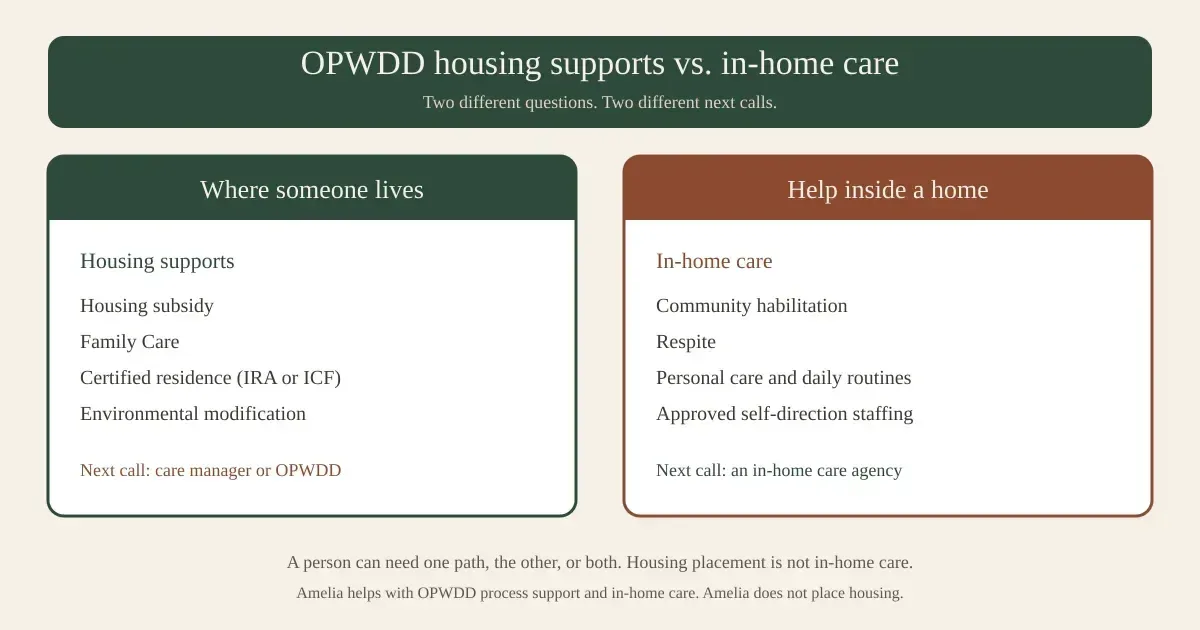
Families may also ask how a service connects to the person’s goals and daily routine. Community habilitation, home health aide services, and self-direction are different kinds of support, and availability depends on the relevant program requirements and authorization. Under applicable self-direction arrangements, an eligible family member may have a pathway to become a paid caregiver; program rules apply, and this should not be assumed for every family. Amelia’s family caregiver information can help frame questions about that possibility.
What is a practical first step?
Start with the records you already have and write down the one or two questions causing the most uncertainty. Then ask the care coordinator or relevant program contact which records matter for the next step and how to send them safely. If you are in Brooklyn, the Bronx, Manhattan, Queens, Staten Island, or Westchester County, Amelia can discuss OPWDD process support and possible in-home care pathways. Typical reported OPWDD approval timelines are four to six months, but that is not a promise; timing varies and no particular result is guaranteed.
Frequently asked questions
Is there one official OPWDD documentation checklist for every family?
No single planning list should be treated as universal. What is requested depends on the person and the specific application, assessment, or service step. Confirm current requirements with the responsible program contact.
Should I wait until every record is collected before asking for help?
No. You can ask what applies and how to obtain missing information while organizing records you already have. A missing document does not by itself tell you whether a person is eligible.
Does submitting documents through an app guarantee faster approval?
No. Amelia’s app supports digital document submission and real-time updates, but it does not guarantee approval, eligibility, a faster review, service hours, or any other outcome.
Can a parent’s income affect a child’s OPWDD process?
Amelia’s stated guidance is that the child’s income, rather than the parent’s income, is considered for OPWDD. This does not guarantee eligibility; ask about the rules that apply to the child and the specific services being considered.
Use this checklist to prepare for a conversation, then confirm the current requirements and next steps with the people responsible for your family’s process.