What does self-determination mean in everyday language?
Self-determination is the idea that a person should have a meaningful role in decisions about their own life. That can include expressing preferences, setting personal goals, choosing among appropriate options, and getting support to make decisions. It is a broad principle, not a specific service or promise of a particular support.
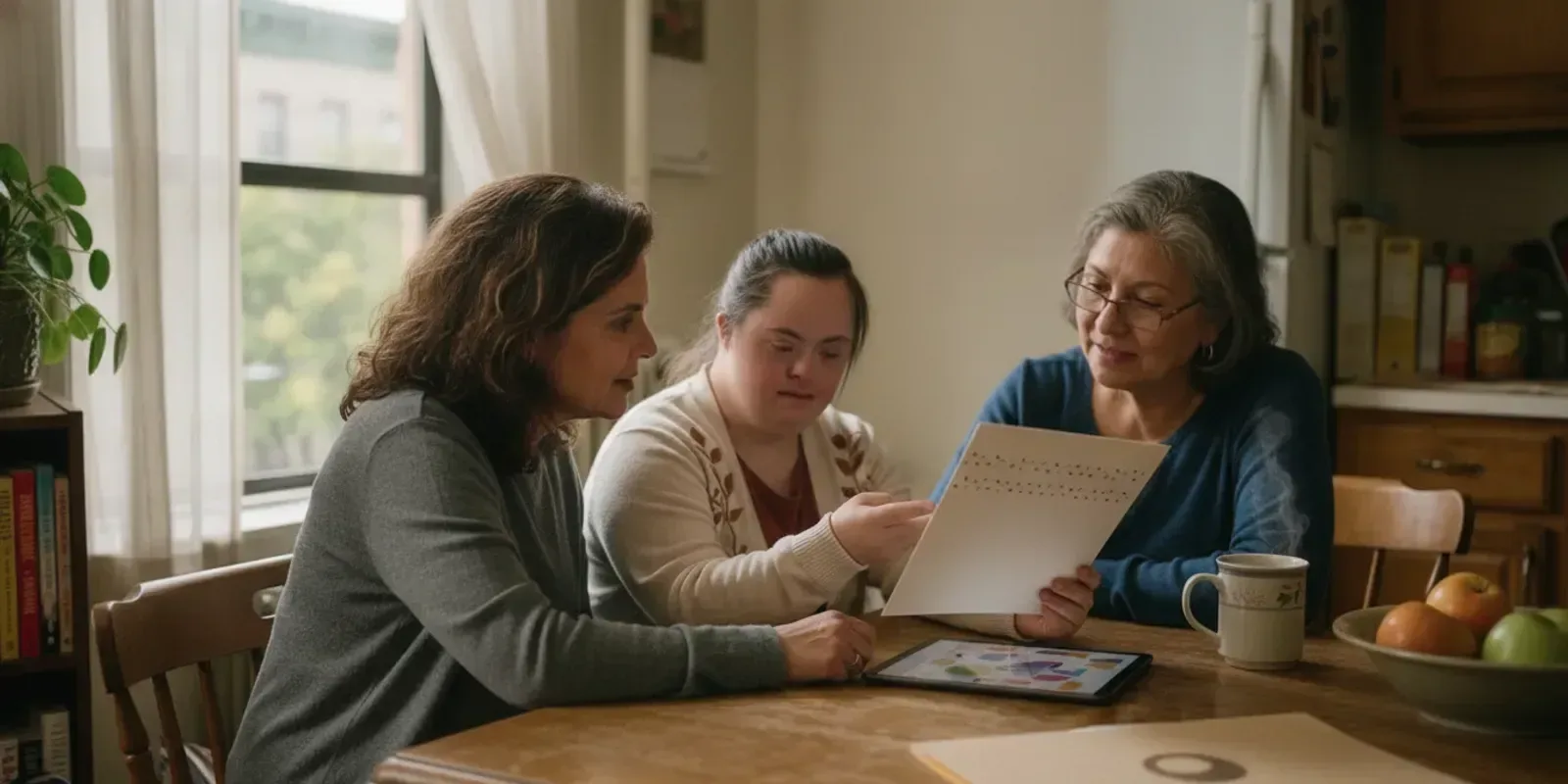
For a person with a developmental disability, having a voice may look different from one person to another. One person may communicate choices verbally. Another may use pictures, a communication device, behavior cues, or support from someone who knows them well. A family can help make those preferences visible, while keeping the person at the center as much as possible.
Self-determination does not mean that a person has to manage every task alone. Nor does it mean that every requested service, budget, schedule, or caregiver arrangement will be available. The person may need trusted assistance to understand options, communicate choices, and work within a program’s rules. That support can include giving the person time to respond, presenting choices in a way they understand, and noticing how they express comfort or preference. Family members and professionals can share what they observe, but should avoid assuming that one person’s preference automatically represents the individual’s own view. If there is uncertainty, it is reasonable to ask the care team how the person can participate in a way that works for them.
This distinction is useful in everyday decisions, not only formal service meetings. A person may have preferences about when an activity happens, which familiar people are involved, or how a routine is explained. Those details can help guide a respectful conversation about supports. They do not, by themselves, establish eligibility for a program or determine what a service plan can include.
How is self-determination different from OPWDD self-direction?
OPWDD is the New York State Office for People With Developmental Disabilities. It supports services for people with developmental disabilities who meet applicable criteria. Self-determination describes a broad value: the person has a voice and participates in choices. OPWDD self-direction refers to a specific way some eligible people may have greater involvement in arranging and directing approved supports, within program requirements.
A helpful way to remember the distinction is that self-determination is the principle, while self-direction is a program approach that may put some of that principle into practice. The terms are often used loosely in conversation, so families should ask what someone means when they use them. The details depend on the person’s situation, their approved plan, and the rules that apply.
Self-direction is not the same thing as choosing any service without limits or receiving funds without oversight. It is also not an automatic result of asking for it. A family can explore whether it may be relevant, what steps are involved, and what choices are actually available. The official New York OPWDD website is a starting point for agency information; families should confirm current program details with the appropriate care team.
What kinds of choices might families be talking about?
When a family says it wants more self-determination, it may mean several different things. It could be asking how the person’s preferences can be included in planning, whether support can fit a daily routine, or how to make activities in the home and community more meaningful. Another family may be asking about self-direction as a service arrangement. Those are related conversations, but they are not identical.
It helps to describe the need behind the phrase. For example, rather than asking only, “Can we have self-determination?” a family might say: “We want our adult daughter’s interests to guide her community activities. What planning options should we ask about?” Or a parent might ask: “Our child communicates choices with pictures. How can those preferences be included when we discuss supports?” These questions give care professionals a clearer starting point without presuming an answer.
Some families also want to understand whether an eligible family member can serve as a paid caregiver through applicable self-direction arrangements. Program rules apply, and eligibility and roles depend on the individual circumstances. A parent or legal guardian cannot be a paid aide for their own child through the described pathway. Families should ask specifically which arrangements are permitted rather than assume that a relative can be hired.
What is the difference between the terms?
The comparison below offers a plain-language distinction. It is a conversation aid, not a statement that a person qualifies for a program or that a particular option will be approved.
Self-determination
Plain-language meaning: A broad principle of having a voice and participating in decisions about one’s life.
Useful question to ask: How can this person’s preferences and communication be included in planning?
Self-direction
Plain-language meaning: A program approach that may allow an eligible person greater involvement in arranging approved supports, within applicable rules.
Useful question to ask: Could this approach be relevant, and what steps and responsibilities should we understand?
Service planning
Plain-language meaning: A process for discussing needs, goals, available supports, and next steps with the relevant team.
Useful question to ask: Who should be involved, and what information would make the discussion useful?
Care coordination
Plain-language meaning: Help connecting a person and family with relevant providers, information, and follow-up.
Useful question to ask: Who will help track questions, documents, and communication across the process?
How can families prepare for a conversation?
Families do not need to have all the terminology settled before asking for help. A short description of what matters to the person can make a first conversation more practical. Consider noting:
- The person’s own preferences: What activities, routines, relationships, or goals matter to them? How do they communicate a choice?
- Current support needs: What is difficult at home, school, work, or in the community? Share concrete examples rather than relying on broad labels alone.
- Existing services and contacts: Which care manager, coordinator, provider, or community organization is already involved? Identify the best person to coordinate with.
- Questions about self-direction: Are you asking about the general principle of having more say, or about a particular way to arrange approved services?
- Practical constraints: Are there language, transportation, scheduling, or communication needs that should be discussed?
Keep notes focused on what is needed to arrange a conversation. Avoid sending sensitive health or identity documents through an unconfirmed channel. Ask the relevant provider how to submit records securely and which documents are actually needed. Amelia’s app supports digital document submission and real-time updates during the OPWDD process, but using it does not guarantee eligibility, approval, faster processing, service hours, or a particular outcome.
Families starting to explore eligibility and application steps can review Amelia’s guide to applying for OPWDD services and its OPWDD documentation checklist. These resources can help organize questions; they do not replace a discussion about the individual’s circumstances.
What should referral partners clarify before making a handoff?
Care managers, social workers, hospital discharge and care-coordination teams, and nonprofit or community-organization staff may be supporting families who are hearing unfamiliar terms under pressure. A useful referral does not have to resolve every question. It can help the family understand whom to contact and what the next conversation is for.
Before referring, consider confirming the family’s preferred contact method and language, whether they are asking about OPWDD application support or self-direction, and which provider or coordinator is already involved. If the family has records, do not forward personal health information without consent and an appropriate secure process. A brief description of the question—without unnecessary sensitive details—can make a warm handoff easier.
Referral partners can also help separate an urgent practical need from a longer-term planning question. A family may need support understanding an OPWDD application, while also wanting to know how the person’s preferences can shape future services. Naming both needs helps the family understand what can be discussed now and what may require coordination with an existing care manager or other program contact. Avoid describing a referral as a determination of eligibility; it is a way to connect the family with a conversation.
When possible, tell the family what the next contact is intended to cover and what information they may want nearby, such as a short summary of current supports and their questions. Check that the family is comfortable with the referral and with any information being shared. If a language preference or communication support would help, note that before the handoff. These small steps can reduce repeated explanations and give the family a clearer sense of what to expect from an initial discussion, without suggesting that a specific service or result is assured.
Amelia Home Care supports New York families with OPWDD eligibility and application management, pediatric home health aide care, community habilitation, and self-direction support. Its team can discuss what information may help clarify next steps. Eligible OPWDD-funded services may be available at $0 cost to the family, subject to program rules; this does not mean that every person or service qualifies. Amelia serves families across New York City and Westchester County. For related information, see its page about OPWDD and home care for children with special needs or its overview of OPWDD care coordination.
How can Amelia help families explore the next step?
Amelia is a New York Licensed Home Care Services Agency that helps families navigate OPWDD and Medicaid-funded in-home care. Its OPWDD process support can help families understand the application pathway and coordinate practical next steps. Bilingual intake is available, and aides speak seven languages. These supports can make communication more accessible, but they do not determine eligibility or guarantee an outcome.
Families may also ask whether an eligible family member could become a paid caregiver under applicable self-direction arrangements. Program rules apply, and a parent or legal guardian cannot be a paid aide for their own child through the described pathway. If a family’s question is broader than OPWDD, Amelia also offers adult and senior home care and other program-related services. The right conversation depends on the person’s needs and situation.
For a first discussion, a family can explain what choices they hope the person can make, what support is currently in place, and what they mean by “self-determination.” A care manager or social worker can help identify the appropriate referral destination and coordinate with the family, with consent. A consultation is an opportunity to ask questions, not a promise that a particular program or service will be available.
Frequently asked questions
Is self-determination the same as self-direction?
No. Self-determination is a broad principle about having a voice in decisions. Self-direction is a specific approach that may give an eligible person greater involvement in arranging approved supports, subject to program rules.
Does wanting self-direction mean a person will qualify?
No. A person’s interest in self-direction does not establish eligibility or guarantee a service, budget, caregiver arrangement, or approval. Families should discuss the person’s circumstances with the appropriate program or care team.
Can any family member be paid as a caregiver?
Not necessarily. Applicable rules determine which arrangements may be allowed. A parent or legal guardian cannot be a paid aide for their own child through the described pathway. Ask about the specific relationship and circumstances rather than assuming a family member can be paid.
What should I bring to an initial conversation?
Bring a concise description of the person’s goals, communication preferences, current support needs, and the question you want answered. Ask first how to share documents securely, and send only information requested through an appropriate channel.
Talk with Amelia about OPWDD next steps
What is a practical next step?
Start with the person’s own preferences and describe the decision or support question behind the words “self-determination.” Families and referral partners can then ask whether the conversation is about a broad planning principle, OPWDD self-direction, or another service pathway, and get guidance suited to the individual situation.